
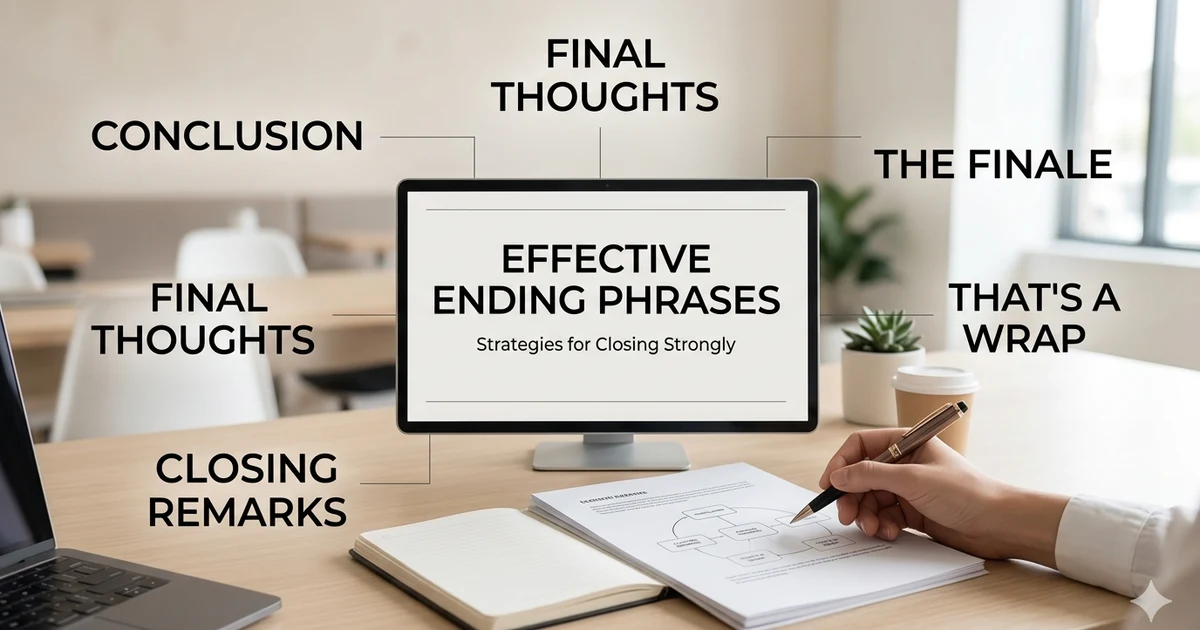
If you are looking for other ways to say the end, you may be finishing a story, presentation, speech, movie script, email, or creative project. While the phrase the end is simple and widely understood, many alternatives can sound more professional, creative, formal, dramatic, or modern depending on the situation.
This guide explains the meaning of the phrase, when to use it, and the best alternatives for different contexts.
Quick Answer
Other ways to say the end include:
- Conclusion
- Final Thoughts
- Closing Remarks
- Finis
- End of Story
- That’s All
- Curtain Call
- The Finale
- Wrapping Up
- Last Word
The best choice depends on whether you are writing a book, ending a presentation, closing a speech, or finishing an online conversation.
TL;DR
- Meaning: Indicates that something has finished.
- Tone: Can be neutral, formal, creative, dramatic, or casual.
- Common use: Books, stories, presentations, speeches, and videos.
- Where it appears: Writing, entertainment, education, and business communication.
- Formal or informal: Both, depending on the alternative used.
- Best approach: Choose a phrase that matches your audience and purpose.
What Other Ways to Say The End Means
The phrase the end signals that a story, event, presentation, discussion, or piece of content has reached its conclusion.
People often search for alternatives because they want:
- A more professional ending
- A creative closing line
- A stronger final impression
- A phrase that fits a specific audience
Different situations call for different endings. A business presentation may need a professional closing, while a novel or film might benefit from something more artistic.
Basic Explanation
The end is one of the oldest and simplest ways to indicate completion.
It can mean:
- A story has finished
- A discussion is over
- A presentation has concluded
- A process is complete
- There is nothing more to add
Many modern writers and speakers prefer alternatives that sound more natural or engaging.
How People Use It in Writing and Online Conversation
Today, people use ending phrases in many settings:
In books and stories
Writers may use:
- Finis
- End of Story
- The Conclusion
In presentations
Speakers often choose:
- Thank You
- Final Thoughts
- Closing Remarks
In videos and content creation
Creators may use:
- That’s a Wrap
- Thanks for Watching
- Until Next Time
In casual texting
People sometimes say:
- That’s it
- That’s all
- End of discussion
- Case closed
Tone and Emotional Meaning
Different alternatives create different feelings.
| Phrase | Tone |
|---|---|
| Conclusion | Professional |
| Final Thoughts | Thoughtful |
| That’s All | Casual |
| Finis | Literary |
| End of Story | Firm |
| Curtain Call | Theatrical |
| The Finale | Dramatic |
| Wrapping Up | Friendly |
| Last Word | Reflective |
| Case Closed | Decisive |
Common Situations Where It Appears
You might need an alternative when:
- Finishing a presentation
- Ending a report
- Closing a speech
- Completing a novel
- Publishing a blog post
- Ending a video
- Finishing a podcast episode
- Wrapping up a classroom lesson
- Concluding a meeting
- Ending an online discussion
Examples in Real Conversations
Situation
Ending a business presentation
Example
Final Thoughts: Thank you for your time and attention.
Meaning
The presentation has concluded professionally.
Situation
Ending a story
Example
And so their adventure came to a close.
Meaning
The narrative is finished.
Situation
Ending a debate
Example
Case closed.
Meaning
The speaker considers the matter settled.
Situation
Finishing a video
Example
Thanks for watching. Until next time.
Meaning
The current content has ended.
Situation
Wrapping up a meeting
Example
That concludes today’s agenda.
Meaning
The meeting is officially over.
Similar Terms and Related Phrases
Conclusion
Often used in reports, essays, and presentations.
Closing Remarks
Common in speeches and professional events.
Final Thoughts
Useful when summarizing key points.
Finis
A traditional literary term meaning the work is complete.
That’s a Wrap
Popular in film production and casual settings.
Curtain Call
Associated with theater and performances.
End of Story
A stronger phrase that may imply finality or certainty.
75+ Alternatives to The End
Professional Alternatives
- Conclusion
- Closing Remarks
- Final Thoughts
- Summary
- In Closing
- Concluding Statement
- Closing Summary
- Final Notes
- Wrap-Up
- Completion
Creative Alternatives
- Finis
- The Finale
- Curtain Call
- The Last Chapter
- Journey’s End
- The Final Scene
- The Closing Act
- End of the Road
- The Grand Finale
- The Last Page
Casual Alternatives
- That’s All
- That’s It
- We’re Done
- All Finished
- Done and Dusted
- Wrap-Up Time
- Finished
- Over and Out
- End of Discussion
- Case Closed
Presentation Alternatives
- Thank You
- Questions?
- Final Thoughts
- Closing Remarks
- Key Takeaways
- Summary
- Discussion Complete
- Session Complete
- Presentation Complete
- Thank You for Listening
Storytelling Alternatives
- And They Lived Happily Ever After
- End of Story
- The Adventure Ends Here
- Their Journey Was Complete
- The Story Concludes
- The Final Chapter
- A New Beginning
- The Last Word
- The Tale Ends
- Story Complete
Formal Alternatives
- Concluded
- Completed
- Officially Closed
- Finalized
- Brought to a Close
- Reached Its Conclusion
- Successfully Completed
- Concluding Remarks
- Final Outcome
- Closure
Dramatic Alternatives
- The Curtain Falls
- The Final Act
- The End Has Come
- The Last Scene
- Darkness Falls
- The Closing Moment
- The Final Bow
- The Journey Ends
- The Last Chapter Closes
- The Finale Begins
Modern Content Creator Alternatives
- Thanks for Watching
- See You Next Time
- Stay Tuned
- Catch You Later
- That’s a Wrap
- Until Next Time
- Thanks for Joining Us
- Episode Complete
- Stream Ended
- Signing Off
When You Should Use These Alternatives
Choose your ending based on context.
Use professional options when:
- Giving presentations
- Writing reports
- Sending business communications
- Delivering speeches
creative options when:
- Writing fiction
- Producing videos
- Creating artistic projects
casual options when:
- Chatting with friends
- Posting on social media
- Sending informal messages
When You Should Avoid Certain Alternatives
Some alternatives may not fit every situation.
Avoid highly casual phrases when:
- Writing academic papers
- Sending professional emails
- Delivering executive presentations
Instead of dramatic phrases use:
- Preparing formal reports
- Writing business documents
Avoid literary phrases if:
- Your audience may not understand them
- Clarity is more important than style
Is It Formal or Informal?
The answer depends on the phrase.
| Alternative | Formality |
|---|---|
| Conclusion | Formal |
| Closing Remarks | Formal |
| Final Thoughts | Semi-formal |
| Thank You | Professional |
| Finis | Literary |
| That’s All | Informal |
| Case Closed | Informal |
| That’s a Wrap | Casual |
| Curtain Call | Creative |
| End of Story | Casual to firm |
Common Misunderstandings
People sometimes assume all ending phrases mean exactly the same thing.
That is not always true.
For example:
- End of Story can sound dismissive.
- Case Closed may suggest there is no room for discussion.
- Final Thoughts often invites reflection.
- Thank You focuses on audience appreciation rather than finality.
Context matters.
USA and Tier 1 Country Usage
In the United States, Canada, the United Kingdom, Australia, and other English-speaking countries, people commonly use different closing phrases based on the situation.
Professional settings typically favor:
- Conclusion
- Closing Remarks
- Final Thoughts
Creative industries often use:
- That’s a Wrap
- Curtain Call
- The Finale
Casual conversations commonly use:
- That’s It
- That’s All
- Over and Out
Most English speakers easily understand these alternatives.
Quick Reference Table
| Context | What It Means | Tone | Best Use | Avoid If |
|---|---|---|---|---|
| Conclusion | Final section | Professional | Reports | Casual chats |
| Final Thoughts | Last reflections | Thoughtful | Presentations | Very short messages |
| That’s All | Nothing more to add | Casual | Friends | Formal settings |
| Finis | Work is complete | Literary | Books | Business writing |
| That’s a Wrap | Finished | Friendly | Videos | Academic work |
| End of Story | Matter settled | Firm | Discussions | Sensitive conversations |
| Curtain Call | Performance ending | Theatrical | Arts | Corporate reports |
| Case Closed | Issue resolved | Decisive | Informal debate | Collaborative meetings |
| Thank You | Closing and appreciation | Professional | Presentations | Fiction endings |
| The Finale | Final part | Dramatic | Entertainment | Formal documents |
Conclusion
Knowing other ways to say the end helps you match your closing words to the situation. A business presentation may need Conclusion or Closing Remarks, while a story might end with Finis, The Final Chapter, or End of Story. Choosing the right phrase can make your ending feel more professional, memorable, or natural for your audience.
FAQs
What are some professional alternatives to the end?
Good professional options include Conclusion, Closing Remarks, Final Thoughts, Summary, and In Closing.
What is another word for the end in a presentation?
Common choices are Final Thoughts, Closing Remarks, Key Takeaways, Thank You, and Conclusion.
Is the phrase the end outdated?
Not necessarily. It is still widely understood, especially in stories and creative works, but many people prefer more modern alternatives depending on the context.
What is a creative way to say the end?
Creative options include Finis, Curtain Call, The Finale, The Last Chapter, and Journey’s End.
Can I use that’s a wrap instead of the end?
Yes. That’s a Wrap is popular in casual conversation, videos, filmmaking, and content creation.
What is the most formal replacement for the end?
Conclusion is usually the most formal and widely accepted alternative.
Is end of story rude?
Sometimes. It can sound firm or dismissive because it suggests that no further discussion is needed.