
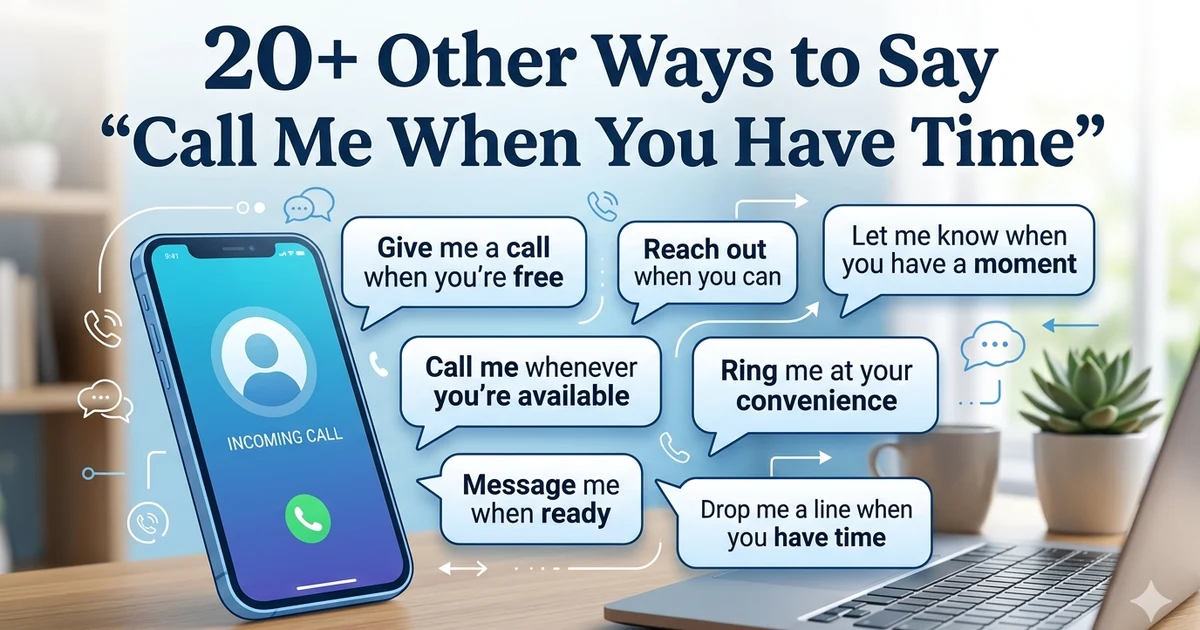
Sometimes you want someone to contact you later, but the words you choose can change how your message sounds. You may want to sound professional, friendly, polite, or a little more relaxed. If you have searched for other ways to say call me when you have time, you are probably looking for a phrase that fits a specific situation. Whether you are texting a friend, messaging a coworker, or emailing a client, there are plenty of natural alternatives that feel more personal and appropriate.
professional ways to request a phone call
Quick Answer
There are many polite alternatives to call me when you have time, including give me a call when you’re free, reach out when you get a chance, let me know when you’re available, and call me at your convenience. The best choice depends on your relationship with the other person and whether the conversation is personal, casual, or professional.
TL;DR
- Meaning: A polite request asking someone to call when they are available.
- Tone: Usually friendly, respectful, and patient.
- Common use: Text messages, emails, workplace chats, and personal conversations.
- Where it appears: Everyday communication, business messages, and social media direct messages.
- Formal or informal: Works in both, depending on the wording you choose.
What Call Me When You Have Time Means
The phrase asks someone to contact you by phone whenever they have a free moment. It does not demand an immediate response, which makes it sound considerate and respectful of the other person’s schedule.
People often use it when:
- The matter is important but not urgent.
- They want to discuss something that is easier to explain over the phone.
- They do not want to interrupt the other person’s day.
- They want to avoid putting pressure on the recipient.
Because it leaves the timing up to the other person, the phrase generally sounds polite rather than demanding.
Basic Explanation
Unlike abbreviations or internet slang, call me when you have time is simply a common English expression.
Its message is straightforward:
- Call me.
- Do it whenever you are free.
- There is no immediate rush unless stated otherwise.
If the matter becomes urgent, it is better to mention that directly instead of relying on this phrase.
For example:
- Please call me as soon as you can. It’s important.
- Give me a call today if possible.
- I need your input before 3 p.m. if you’re available.
These versions communicate urgency more clearly.
How People Use It in Texting and Online Conversation
This phrase appears across many forms of digital communication, including:
- Text messages
- Workplace chat apps
- Facebook Messenger
- Instagram direct messages
- Business emails
Many people shorten it or replace it with more conversational wording.
For example:
- Give me a call when you’re free.
- Let me know when you can talk.
- Reach out whenever you have a minute.
- We should chat when you have some time.
- I’d love to catch up when you’re available.
These alternatives sound natural in everyday American, Canadian, British, and Australian English.
Tone and Emotional Meaning
The phrase usually carries a positive and respectful tone.
Depending on the situation, it can feel:
| Situation | Tone |
|---|---|
| Talking to a friend | Relaxed and friendly |
| Messaging family | Caring and personal |
| Speaking with a coworker | Professional and polite |
| Contacting a client | Respectful and courteous |
| Following up after a meeting | Organized and considerate |
Adding a few extra words can soften the request even more.
For example:
- Whenever you have a few minutes.
- If you have time today.
- At your convenience.
- When your schedule allows.
These additions make the request feel even less demanding.
Common Situations Where It Appears
People commonly use this type of message in many everyday situations.
Following up after a meeting
You need to discuss details that are easier to explain over the phone.
Example:
Please give me a call when you’re free so we can go over the next steps.
Asking a friend for advice
You want their opinion but know they may be busy.
Example:
Call me whenever you have a chance. I’d love your advice on something.
Checking in with family
You simply want to catch up without interrupting them.
Example:
Give me a call when you have some free time.
Talking with a customer or client
You want to remain professional while respecting their schedule.
Example:
Please call me at your convenience to discuss your account.
Planning an event
You need to coordinate details.
Example:
Let me know when you’re available for a quick call.
Other Ways to Say Call Me When You Have Time
Here are some natural alternatives for different situations.
| Alternative | Best For | Tone |
|---|---|---|
| Give me a call when you’re free | Friends, coworkers | Friendly |
| Reach out when you get a chance | Professional communication | Polite |
| Let me know when you’re available | Scheduling | Neutral |
| Call me at your convenience | Business emails | Formal |
| Whenever you have a minute, give me a call | Casual conversations | Relaxed |
| I’d appreciate a call when you have time | Professional requests | Respectful |
| We should talk when you’re free | Friends and family | Warm |
| Feel free to call whenever it works for you | Flexible scheduling | Friendly |
| Can you give me a ring when you’re available? | Informal conversations | Casual |
| Let’s connect when you have some time | Networking and business | Professional |
Each option communicates the same basic idea but creates a slightly different impression.
Examples in Real Conversations
Situation
You are texting a coworker.
Example
Hi Sarah, when you finish your meeting, give me a call when you’re free.
Meaning
There is no urgency. You are waiting until her schedule opens up.
Situation
You are messaging a close friend.
Example
Whenever you have some time tonight, give me a call. I have something funny to tell you.
Meaning
The message feels casual, warm, and relaxed.
Situation
You are emailing a client.
Example
Please call me at your convenience so we can review the proposal together.
Meaning
The wording sounds respectful and professional.
Situation
You are checking in with a family member.
Example
Call me whenever you have a few minutes. I’d love to hear how things are going.
Meaning
The request shows care without creating pressure.
Situation
You are arranging plans.
Example
Let me know when you’re available for a quick call about Saturday.
Meaning
You are trying to coordinate details while respecting the other person’s schedule.
polite ways to ask if someone is available
Similar Phrases and How They Compare
Several expressions have nearly the same meaning, but they work best in different contexts.
| Phrase | Best Used When | Difference |
|---|---|---|
| Give me a call when you’re free | Everyday conversations | Casual and friendly |
| Let me know when you can talk | You are flexible about phone or video | Focuses on availability |
| Reach out when you get a chance | Professional settings | Slightly broader than a phone call |
| We should talk soon | You want to reconnect | Less specific about timing |
| Call me as soon as you can | Something is important | Implies urgency |
| Contact me when convenient | Formal communication | Works for phone, email, or messages |
These alternatives help you match your wording to the situation instead of using the same phrase every time.
When You Should Use It
This type of message works well when you want to speak with someone but do not need an immediate response. It respects the other person’s schedule and gives them flexibility to reply when they are available.
Good situations include:
- Following up after a meeting
- Asking a friend to catch up
- Discussing project details with a coworker
- Talking with a client about a proposal
- Checking in with family members
- Planning an event or appointment
If your request is time-sensitive, mention that clearly instead of leaving the timing open.
For example:
- Please call me before 3 p.m. if possible.
- Could you give me a quick call today?
- I need to confirm something before this afternoon.
These messages help avoid confusion about urgency.
When You Should Avoid It
Although this phrase is polite, it is not always the best choice.
Avoid using it when:
- The matter is urgent.
- A text message would answer the question faster.
- The other person prefers email or messaging.
- You need a written record of the conversation.
- You are contacting someone outside normal business hours unless the matter is important.
Choosing the right communication method can save time for both people.
Is It Formal or Informal?
The expression itself is neutral, which means it can fit both casual and professional communication with small adjustments.
| Setting | Appropriate? | Better Wording |
|---|---|---|
| Texting friends | Yes | Give me a call when you’re free. |
| Family chats | Yes | Call me whenever you have time. |
| Workplace chat | Yes | Let me know when you’re available for a quick call. |
| Business email | Yes | Please call me at your convenience. |
| Customer support | Yes | Feel free to contact me when it’s convenient. |
| Academic setting | Yes | Please let me know a suitable time to talk. |
For professional communication, adding polite words like please, at your convenience, or when you’re available makes the request sound more respectful.
Common Misunderstandings
Most people understand this phrase correctly, but context still matters.
Some common misunderstandings include:
Assuming the issue is urgent
If someone receives a message saying call me when you have time, they may worry something is wrong.
To avoid unnecessary concern, you can add context.
Example:
When you have time, give me a call. I just have a quick question.
Thinking a phone call is required
Sometimes people would rather text than call.
If you’re flexible, say:
- Let me know when you can talk.
- Message or call when you’re free.
- Reach out when you have a chance.
Not Knowing the Time Frame
Without additional details, the other person may wait until the next day or later.
If timing matters, include it.
Example:
If you have time this afternoon, give me a call.
professional ways to confirm a scheduled call
How People in the USA and Other English-Speaking Countries Use It
This phrase is widely understood across English-speaking countries, including the United States, Canada, the United Kingdom, Australia, and New Zealand.
In everyday conversations, people often choose slightly different wording depending on local habits.
Common American alternatives include:
- Give me a call when you’re free.
- Hit me up when you have a minute.
- Let me know when you can talk.
In Canada, Australia, and the UK, you’ll also hear:
- Give me a ring when you’re free.
- Call me when you get a chance.
- Let me know when you’re available.
While the wording varies slightly, the meaning stays the same. Each version politely asks the other person to call when it fits their schedule.
Quick Reference Table
| Context | What It Means | Tone | Best Use | Avoid If |
|---|---|---|---|---|
| Friend | Call when you’re free | Casual | Catching up | The matter is urgent |
| Family | Contact me when you have time | Caring | Checking in | Immediate response is needed |
| Coworker | Let’s talk when you’re available | Professional | Project discussions | A quick text would solve it |
| Client | Call at your convenience | Respectful | Business conversations | You need written documentation |
| Networking | Let’s connect when you have time | Friendly and professional | Building relationships | The request has a strict deadline |
| Team chat | Let me know when you can talk | Neutral | Workplace coordination | An email is more appropriate |
Conclusion
There are many other ways to say call me when you have time, and the best choice depends on who you’re speaking with and the situation. Casual conversations usually work well with phrases like give me a call when you’re free, while professional communication often sounds better with call me at your convenience or let me know when you’re available. The key is to match your wording to the relationship and the level of urgency. A thoughtful choice of words helps your message sound clear, polite, and respectful, whether you’re texting a friend, contacting a client, or following up with a coworker.
FAQs
What are other ways to say call me when you have time?
Some natural alternatives include:
- Give me a call when you’re free.
- Let me know when you’re available.
- Reach out when you get a chance.
- Call me at your convenience.
- Whenever you have a minute, give me a call.
- Let’s connect when you have some time.
Choose the one that best matches the situation and your relationship with the other person.
Is call me when you have time polite?
Yes. It is generally considered polite because it allows the other person to respond when they are available. It respects their schedule instead of asking for an immediate call.
Can I use call me when you have time in a professional message?
Yes. It works well in workplace communication, especially if the matter is not urgent. For a more formal tone, you can say:
- Please call me at your convenience.
- Let me know when you’re available for a quick call.
- I’d appreciate a call when you have time.
These alternatives sound courteous and professional.
Is this phrase too casual for business emails?
Not necessarily. While the original phrase is acceptable in many workplaces, more polished alternatives often fit business emails better.
Examples include:
- Please give me a call at your convenience.
- Let me know a suitable time to talk.
- Feel free to reach out when you’re available.
Does call me when you have time mean the conversation is urgent?
No. In most cases, it suggests the opposite. It tells the other person there is no immediate rush.
If the matter is urgent, it’s better to say:
- Please call me as soon as possible.
- I need to speak with you today if you can.
- Could you call me before this afternoon?
These phrases make the urgency clear.
What is the difference between call me when you have time and call me when you get a chance?
The meanings are almost identical.
- Call me when you have time emphasizes the person’s availability.
- Call me when you get a chance sounds a little more conversational and is very common in everyday texting.
Both are polite and widely understood.
Can I use this phrase in a text message?
Yes. It is one of the most common ways to ask someone for a phone call without sounding demanding.
Examples:
- Give me a call when you have time.
- Let me know when you’re free to chat.
- Reach out when you get a chance.
These messages feel friendly and natural in everyday conversations