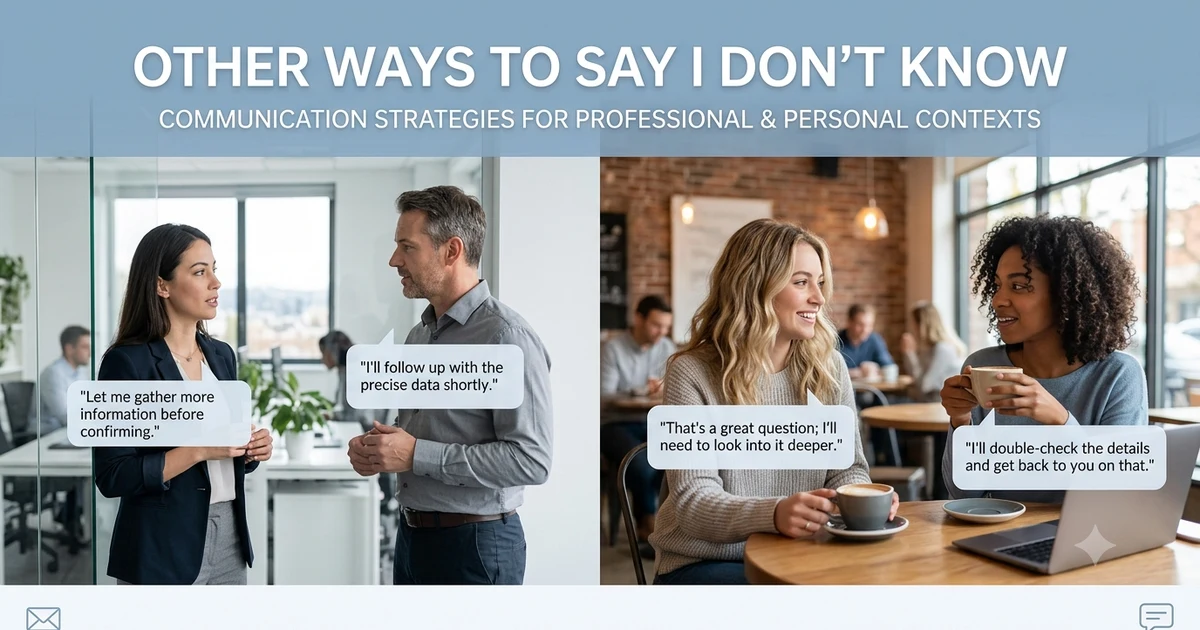
Sometimes saying I don’t know is the most honest response. Still, the way you express uncertainty can change how people understand your message. A different phrase may sound more professional at work, more polite in a conversation, or more natural in a text message.
If you are looking for other ways to say I don’t know, this guide shares practical alternatives for emails, everyday conversations, texting, customer service, school, and social media. You’ll also learn when each expression works best and what tone it conveys.
Quick Answer
Other ways to say I don’t know include I’m not sure, I don’t have that information, I’ll find out, I can’t say for certain, Your guess is as good as mine, Beats me, and I haven’t looked into it yet. The best choice depends on whether you want to sound formal, casual, professional, or friendly.
TL;DR
- Meaning: A different way to admit that you do not have the answer.
- Tone: Can be formal, casual, polite, humorous, or professional.
- Common use: Conversations, emails, text messages, meetings, and customer support.
- Where it appears: Everyday speech, workplace communication, online chats, and social media.
- Formal or informal: Many alternatives work in professional settings, while others fit only casual conversations.
What It Means
Saying I don’t know simply means you do not have the information, answer, or certainty needed to respond.
That does not always mean you lack knowledge. Sometimes you have not checked the facts yet, need more time, or do not want to make an incorrect statement.
Choosing a different phrase can help you:
- Sound more polite.
- Show honesty without appearing careless.
- Keep conversations positive.
- Maintain professionalism.
- Express different levels of certainty.
For example, there is a difference between saying:
- I’m not sure.
- I haven’t confirmed that yet.
- I’ll check and let you know.
Each sentence tells the listener something slightly different.
Understanding the Phrase
Unlike abbreviations or internet slang, I don’t know is a complete English phrase rather than a shortened form.
People often replace it with alternatives because the original wording can sometimes sound too blunt or repetitive.
Different replacements communicate different meanings.
- Some show uncertainty.
- Some promise to find the answer.
- Some politely avoid guessing.
- Some add humor.
- Some sound confident even while admitting uncertainty.
That flexibility makes it useful to know several alternatives.
How People Use It in Texting and Online Conversations
In casual texting, people often shorten their responses to keep conversations moving.
Common examples include:
- IDK
- Not sure
- No clue
- Beats me
- Haven’t checked yet
- I’m still figuring it out
- I honestly don’t know
- I wish I knew
These expressions appear frequently in:
- Text messages
- Group chats
- Instagram comments
- Facebook discussions
- Reddit conversations
- Discord servers
- TikTok comments
- Snapchat chats
A friend asking where everyone is meeting might receive a simple reply like:
Not sure. I’ll ask the group.
Someone discussing a new movie might answer:
Haven’t seen it yet, so I can’t say.
In online conversations, shorter responses often feel more natural than repeating I don’t know every time.
Tone and Emotional Meaning
The same idea can sound very different depending on your wording.
Polite
These phrases sound respectful and thoughtful.
- I’m not sure.
- I can’t say for certain.
- I don’t have that information.
- I’ll check for you.
- Let me find out.
Professional
These work well in business settings.
- I’ll confirm that.
- I don’t have the details at the moment.
- I’ll look into it.
- I’ll verify the information.
- Let me get back to you.
Casual
Friends often use these naturally.
- Beats me.
- No clue.
- Not sure.
- Your guess is as good as mine.
- Haven’t got a clue.
Honest
These show transparency.
- I honestly don’t know.
- I haven’t checked.
- I couldn’t tell you.
- I haven’t learned that yet.
Humorous
These add a lighthearted tone.
- That’s above my pay grade.
- If only I knew.
- I’m wondering the same thing.
- Your guess is as good as mine.
The tone should always match the situation. A funny response may work with close friends but not during a business meeting.
Common Situations Where It Appears
People replace I don’t know in many everyday situations.
At Work
- Answering client questions
- Team meetings
- Project discussions
- Customer support
- Status updates
At School
- Classroom discussions
- Homework questions
- Group projects
- Study sessions
With Friends
- Making plans
- Talking about movies
- Discussing sports
- Giving recommendations
Online
- Social media comments
- Gaming chats
- Community forums
- Live streams
Family Conversations
- Travel planning
- Household decisions
- Event planning
- Everyday discussions
Examples in Real Conversations
Situation
A coworker asks about a project deadline.
Example
I’m not sure yet. I’ll confirm with the project manager this afternoon.
Meaning
You do not know the answer yet, but you plan to verify it.
Situation
A friend asks where everyone is meeting.
Example
No clue. Let me check the group chat.
Meaning
You honestly do not know but intend to find out.
Situation
A customer asks about product availability.
Example
I don’t have that information right now, but I’ll check our inventory.
Meaning
You remain professional while offering help.
Situation
Someone asks whether a TV series has been renewed.
Example
I haven’t looked into it yet.
Meaning
You have not researched the answer.
Situation
A family member asks what time relatives are arriving.
Example
I can’t say for certain. They’re still traveling.
Meaning
You are uncertain rather than completely uninformed.
Situation
Someone asks an opinion about a restaurant.
Example
I haven’t been there yet, so I couldn’t tell you.
Meaning
Your lack of experience prevents you from answering.
Situation
A colleague asks about new company policies.
Example
I’ll verify that before giving you an answer.
Meaning
You prefer accuracy instead of guessing.
Similar Terms and Related Phrases
Many expressions communicate uncertainty, but each has a slightly different meaning.
| Phrase | Best For | Tone | Meaning |
|---|---|---|---|
| I’m not sure | Most situations | Neutral | You are uncertain |
| No clue | Friends | Casual | You have no idea |
| Beats me | Informal conversation | Casual | You do not know either |
| I can’t say for certain | Professional settings | Formal | You lack complete certainty |
| I’ll find out | Workplace | Helpful | You promise to check |
| I haven’t checked yet | Everyday conversations | Neutral | You have not looked into it |
| I don’t have that information | Business communication | Professional | You currently lack the details |
| Your guess is as good as mine | Friends | Humorous | Both people are equally uncertain |
| I honestly don’t know | General conversation | Honest | A direct admission of uncertainty |
| I couldn’t tell you | Casual conversation | Neutral | You do not have the answer |
When You Should Use These Alternatives
Different situations call for different wording. Choosing the right phrase helps you communicate clearly while matching the tone of the conversation.
In Professional Emails
Use responses that show honesty and a willingness to help.
Good choices include:
- I’m not sure, but I’ll find out.
- I don’t have that information at the moment.
- I’ll confirm and get back to you.
- Let me check with the team.
- I’ll verify the details before responding.
These alternatives sound responsible and professional.
During Meetings
If someone asks a question you cannot answer immediately, avoid guessing.
Try saying:
- I don’t have the latest update.
- I’ll confirm after the meeting.
- That’s something I need to verify.
- I’ll follow up with the correct information.
In Everyday Conversations
With friends and family, simple responses usually work best.
Examples include:
- Not sure.
- I have no idea.
- Beats me.
- No clue.
- I couldn’t tell you.
In Customer Service
A helpful response is often better than simply saying you do not know.
Instead, use:
- Let me check that for you.
- I’ll find the correct information.
- I’ll look into it and update you.
- Let me confirm before I answer.
On Social Media
Short replies feel natural.
Examples include:
- Not sure.
- Haven’t seen that yet.
- I honestly don’t know.
- No idea.
- Still figuring it out.
When You Should Avoid These Alternatives
Some expressions sound too casual or dismissive in certain situations.
Avoid slang when:
- Writing business emails.
- Speaking with clients.
- Attending interviews.
- Communicating with teachers.
- Responding to customers.
- Writing formal reports.
For example, Beats me or No clue may sound careless in professional communication.
Likewise, saying Your guess is as good as mine can make it seem as though you are unwilling to help.
When accuracy matters, choose a response that shows you will verify the information.
Is It Formal or Informal?
Most alternatives fall into one of three categories.
Formal
Suitable for business and academic settings.
- I don’t have that information.
- I can’t say for certain.
- I’ll verify that.
- I’ll confirm and let you know.
- Let me check before answering.
Neutral
These work almost anywhere.
- I’m not sure.
- I don’t know yet.
- I haven’t checked.
- I couldn’t tell you.
- I’m uncertain.
Informal
Best for conversations with friends or family.
- No clue.
- Beats me.
- Haven’t got a clue.
- Your guess is as good as mine.
- Who knows.
When in doubt, choose a neutral expression. It is appropriate in nearly every situation.
Common Misunderstandings
People sometimes assume every alternative means exactly the same thing. In reality, the wording often changes the message.
For example:
I’m not sure suggests you may know part of the answer.
I haven’t checked yet means the information exists, but you have not looked for it.
I’ll find out tells the other person you intend to help.
I couldn’t tell you often means you genuinely have no information.
No clue sounds much more casual than I’m not sure.
Understanding these differences helps you communicate more clearly.
Usage in the USA and Other English-Speaking Countries
People across the United States, Canada, the United Kingdom, Australia, and New Zealand commonly use many of these alternatives.
Professional settings often favor phrases such as:
- I’ll confirm that.
- Let me check.
- I don’t have that information.
- I’ll get back to you.
Casual conversations often include:
- Not sure.
- No idea.
- Beats me.
- Who knows.
- Your guess is as good as mine.
While some regional preferences exist, these expressions are widely understood throughout English-speaking countries.
Quick Reference Table
| Context | What It Means | Tone | Best Use | Avoid If |
|---|---|---|---|---|
| Business email | You need to verify information | Professional | Clients and coworkers | You already know the answer |
| Team meeting | You need more information | Professional | Workplace discussions | Immediate decisions are required |
| Text message | You are uncertain | Casual | Friends and family | Formal communication |
| Social media | You have no answer | Casual | Comments and discussions | Professional networking |
| Customer support | You will check first | Helpful | Assisting customers | You can answer immediately |
| School | You have not learned it yet | Neutral | Classroom discussions | Exams requiring an answer |
| Friendly chat | You honestly do not know | Relaxed | Everyday conversation | Speaking with senior professionals |
100+ Other Ways to Say I Don’t Know
Professional Alternatives
- I’m not sure.
- I don’t have that information.
- I’ll confirm that.
- Let me check.
- I’ll find out.
- I’ll verify the details.
- I can’t say for certain.
- I’ll get back to you.
- I need to look into it.
- I don’t have the latest update.
- That’s something I’ll need to confirm.
- I haven’t verified it yet.
- I’m unable to answer that right now.
- I’ll check with the appropriate person.
- Let me gather the facts first.
- I’ll review that information.
- I don’t want to guess.
- I’ll provide an accurate answer shortly.
- I need more information.
- I’ll follow up once I know.
Casual Alternatives
- Not sure.
- No idea.
- No clue.
- Beats me.
- Who knows.
- Haven’t got a clue.
- I couldn’t tell you.
- I’m wondering the same thing.
- I honestly don’t know.
- I wish I knew.
- Search me.
- Good question.
- I’m not certain.
- I haven’t checked.
- I haven’t heard.
- I don’t remember.
- Maybe.
- Could be.
- Hard to say.
- I’m still figuring it out.
Polite Alternatives
- I don’t know yet.
- I haven’t looked into it.
- I haven’t found out.
- I’ll see what I can learn.
- Let me find the answer.
- I’ll ask someone who knows.
- I’d rather not guess.
- I can’t answer confidently.
- I don’t have enough information.
- I’ll check and let you know.
Friendly Alternatives
- That’s a good question.
- I’m not the best person to ask.
- I wish I had the answer.
- I’ll ask around.
- Let’s find out together.
- Maybe someone else knows.
- We’ll have to check.
- I’m curious too.
- I’m unsure.
- Let’s look it up.
Humorous Alternatives
- That’s above my pay grade.
- Your guess is as good as mine.
- If only I knew.
- I’ve been wondering that too.
- The mystery continues.
- I’ve got nothing.
- I’m drawing a blank.
- That’s beyond me.
- Don’t ask me.
- You’ve stumped me.
Conclusion
Knowing other ways to say I don’t know helps you communicate more effectively in different situations. A professional meeting, a casual conversation, and a text message all call for different wording. Choosing the right phrase allows you to be honest while sounding polite, confident, and helpful. Whether you prefer a simple response like I’m not sure or a professional reply such as I’ll confirm and get back to you, the best choice depends on your audience and the situation.
FAQs
What does other ways to say I don’t know mean?
It refers to alternative words and phrases you can use instead of saying I don’t know. These expressions can sound more polite, professional, casual, or friendly depending on the context.
What is the best professional alternative to I don’t know?
Good professional options include I’m not sure, I’ll verify that, I don’t have that information at the moment, and I’ll get back to you after checking.
Is saying I don’t know rude?
No. It is usually seen as honest. However, adding a helpful follow-up such as I’ll find out or Let me check often creates a better impression.
Can I use these alternatives in text messages?
Yes. Short phrases like Not sure, No idea, Haven’t checked yet, and I honestly don’t know are common in texting and online conversations.
What is the difference between I’m not sure and No clue?
I’m not sure suggests some uncertainty and sounds neutral. No clue means you have no information at all and is much more casual.
Which alternative should I use in a job interview?
Avoid slang. Instead, say I’d like to verify that before answering, I’m not certain, or I don’t have that information, but I’m happy to learn more.
Are these expressions common in American English?
Yes. Most of these alternatives are widely used in the United States as well as Canada, the United Kingdom, Australia, and other English-speaking countries.