
Many people search for other ways to say please note professionally because the phrase can sound repetitive, overly formal, or even a little stiff when used too often. Whether you’re writing an email, preparing a report, or sending a workplace message, choosing a different expression can make your communication sound more natural while still getting your point across.
The best alternative depends on your audience and the message you want to emphasize. Some options sound more courteous, while others work better for formal business communication or quick team updates.
Quick Answer
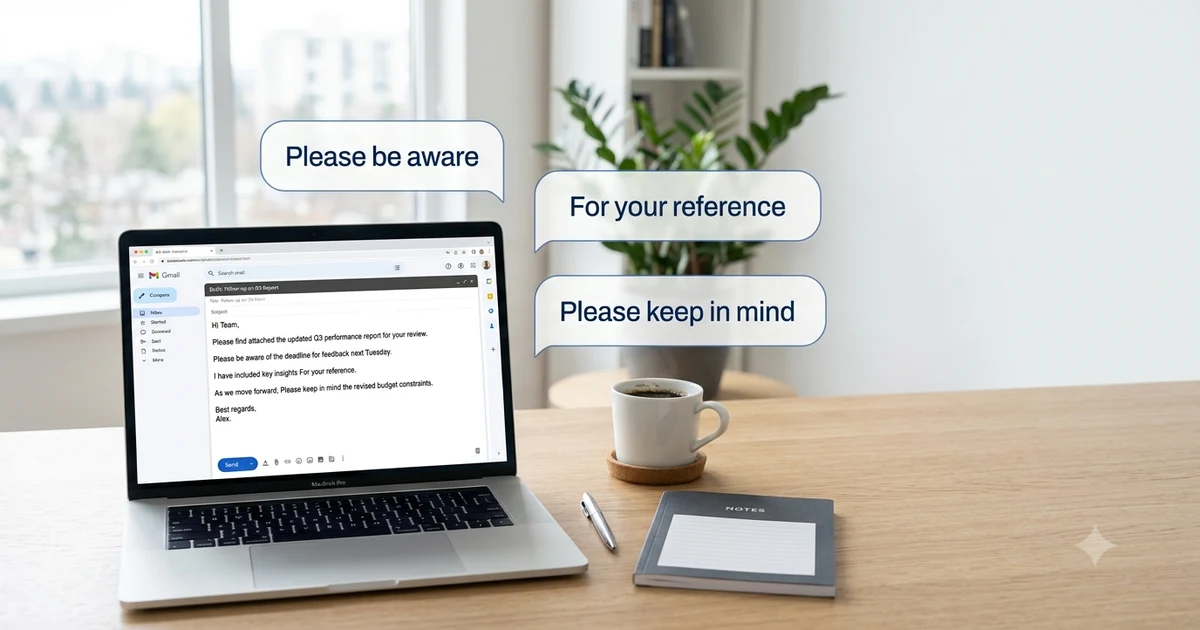
If you want an alternative to please note professionally, consider phrases like please be aware, kindly note, for your reference, please keep in mind, or I’d like to highlight. Each option draws attention to important information while matching different levels of formality.
The most appropriate choice depends on whether you’re writing an email, speaking with clients, or communicating with coworkers.
TL;DR
- Meaning: A polite way to draw attention to important information.
- Tone: Professional, neutral, and respectful.
- Common use: Emails, reports, business letters, and workplace messages.
- Where it appears: Professional communication, customer service, education, and corporate documents.
- Formality: Formal to semi-formal, depending on the alternative you choose.
What Does Please Note Mean?
Please note is a polite expression used to direct someone’s attention to information that is important or relevant. It tells the reader that the following detail deserves special attention.
Although the phrase remains common in professional writing, many people prefer alternatives because repeating it throughout emails or reports can make the writing feel mechanical.
For example:
- Please note that our office will close at 3:00 PM on Friday.
- Please note that payment is due within 14 days.
- Please note the updated meeting location.
In each case, the purpose is the same: helping the reader avoid missing an important detail.
Basic Explanation
The phrase contains two simple parts:
| Word | Meaning |
|---|---|
| Please | A polite marker that softens the request. |
| Note | To pay attention to, remember, or take notice of something. |
Together, they politely ask the reader to pay attention to the information that follows.
Unlike direct commands such as Remember this or Don’t forget, the phrase sounds courteous and suitable for workplace communication.
Why Look for an Alternative?
While there is nothing wrong with using please note, many professionals look for other expressions because they want their writing to sound:
- More conversational
- Less repetitive
- Friendlier
- More customer-focused
- Better suited to modern workplace communication
For example, compare these two emails.
Version 1
Please note that your appointment has been rescheduled.
Version 2
Please be aware that your appointment has been rescheduled.
The second version often feels a little more natural, especially in customer communication.
Likewise:
Instead of
Please note that the deadline is Monday.
You could write
Please keep in mind that the deadline is Monday.
Small changes like these improve readability without changing the meaning.
Professional Alternatives to Please Note
Below are some of the most useful replacements, along with when to use each one.
| Alternative | Best For | Tone |
|---|---|---|
| Please be aware | Announcements and updates | Professional |
| Kindly note | Formal emails | Polite |
| Please keep in mind | Friendly workplace communication | Warm |
| For your reference | Sharing information | Neutral |
| I’d like to highlight | Presentations and reports | Professional |
| Please remember | Reminders | Friendly |
| It’s worth noting | Reports and discussions | Neutral |
| Please take into consideration | Formal recommendations | Professional |
| As a reminder | Follow-up emails | Helpful |
| We would like to inform you | Customer communication | Formal |
Tone and Emotional Meaning
Although please note sounds polite, it can sometimes feel firm because it directs the reader’s attention to something important.
Different alternatives create different impressions.
Professional and neutral
- Please be aware
- For your reference
- We’d like to inform you
These work well in business emails and official notices.
Friendly and approachable
- Please keep in mind
- Just a reminder
- As a reminder
These are often suitable for coworkers and existing clients.
Formal
- Kindly note
- Please take into consideration
- We would like to draw your attention to
These fit legal documents, contracts, and formal correspondence.
Collaborative
- I’d like to highlight
- You may wish to note
- It’s worth mentioning
These sound less commanding and encourage cooperation.
How People Use It in Professional Communication
The phrase and its alternatives appear across many industries because they help readers focus on important information.
Business emails
Instead of writing:
Please note that invoices are due on the last business day of the month.
You could write:
Please keep in mind that invoices are due on the last business day of the month.
Customer service
Instead of:
Please note that delivery may take five business days.
Try:
Please be aware that delivery may take up to five business days.
Internal workplace chats
Instead of:
Please note today’s meeting starts at 2 PM.
You might say:
Just a reminder, today’s meeting starts at 2 PM.
Reports
Instead of:
Please note the following findings.
You could write:
It’s worth noting the following findings.
Project updates
Instead of:
Please note the revised timeline.
Use:
I’d like to highlight the revised project timeline.
Common Situations Where It Appears
You will often see this phrase or its alternatives in situations such as:
- Business emails
- Customer support messages
- HR announcements
- Meeting invitations
- Project updates
- Academic notices
- School communications
- Company policies
- Contracts
- Service agreements
- Training materials
- Reports
- Presentations
- Marketing emails
- Appointment confirmations
Each situation may call for a slightly different level of formality.
Examples in Real Conversations
Situation: Informing a client about a schedule change
Example
Please be aware that your consultation has been moved to Tuesday afternoon.
Meaning
The client should pay attention to the updated appointment.
Situation: Sending an internal reminder
Example
Please keep in mind that expense reports are due by Friday.
Meaning
Employees are being reminded of a deadline.
Situation: Sharing supporting information
Example
For your reference, I’ve attached the revised budget spreadsheet.
Meaning
The attachment provides helpful information for later review.
Situation: Presenting findings
Example
I’d like to highlight the increase in customer satisfaction over the past quarter.
Meaning
The speaker wants the audience to focus on an important result.
Situation: Customer notification
Example
Kindly note that support hours will change during the holiday period.
Meaning
Customers should remember the temporary schedule.
Situation: Team collaboration
Example
As a reminder, the design review begins at 10:00 AM tomorrow.
Meaning
The message gently reminds everyone about the upcoming meeting.
Situation: Formal correspondence
Example
Please take into consideration the revised compliance requirements before submitting your application.
Meaning
The recipient should consider the updated requirements before taking action.
Situation: Report writing
Example
It’s worth noting that customer retention improved by 12 percent compared with last year.
Meaning
The statistic deserves special attention because it is significant.
These examples show that you do not have to rely on a single phrase every time. Choosing the right alternative helps your writing sound more natural while maintaining a professional tone.
Similar Terms and Related Phrases
Many expressions can replace please note, but they are not always interchangeable. Some are more formal, while others sound friendlier or work better in specific situations.
| Phrase | Best Used For | Difference |
|---|---|---|
| Please be aware | Announcements and policy updates | Draws attention to important information. |
| Please keep in mind | Friendly workplace communication | Softer and more conversational. |
| For your reference | Sharing documents or background information | Indicates the information is helpful rather than urgent. |
| As a reminder | Follow-up emails and recurring deadlines | Assumes the reader already knows the information. |
| It’s worth noting | Reports and presentations | Highlights an important point without sounding directive. |
| I’d like to highlight | Meetings and presentations | Places emphasis on a specific detail. |
| Kindly note | Formal business correspondence | More formal than please note. |
| Please remember | Gentle reminders | Better suited to familiar audiences. |
| We would like to inform you | Customer notifications | Formal and informative. |
| Please take into consideration | Recommendations and proposals | Encourages the reader to think about a particular factor. |
Choosing the right phrase depends on your relationship with the reader and the purpose of your message.
When You Should Use It
Using please note or one of its alternatives makes sense when you want readers to notice information that affects them.
Good situations include:
- Announcing schedule changes
- Explaining new policies
- Sharing important deadlines
- Pointing out document updates
- Confirming appointments
- Sending project milestones
- Providing payment instructions
- Explaining service interruptions
- Highlighting safety information
- Clarifying procedures
For example:
Email to a client
Please be aware that your invoice is attached for review.
Project update
I’d like to highlight the revised delivery timeline.
Meeting invitation
Please keep in mind that tomorrow’s meeting begins at 9:30 AM.
Each sentence clearly guides the reader without sounding abrupt.
When You Should Avoid It
Although please note is professional, there are times when another expression works better.
Avoid it when:
- You’re repeating it several times in one email.
- The information is not especially important.
- A warmer tone would improve the relationship.
- The message is already direct and easy to understand.
- You’re writing conversational internal messages.
For example, instead of writing:
Please note that lunch will be served after the presentation.
You could simply write:
Lunch will be served after the presentation.
Sometimes removing the phrase entirely makes your writing more concise.
Similarly, instead of:
Please note that I have attached the document.
A more natural choice is:
I’ve attached the document for your review.
The sentence feels smoother because the attachment is already obvious.
Is It Formal or Informal?
Please note falls between formal and semi-formal English.
Formal communication
Suitable for:
- Business emails
- Client correspondence
- Official notices
- Contracts
- Reports
- Government communication
- Academic administration
Semi-formal communication
Also appropriate for:
- Team emails
- School updates
- Customer service replies
- Workplace announcements
Informal communication
Among friends or family, the phrase often sounds unnecessarily formal.
Instead of:
Please note that dinner starts at six.
Most people would naturally write:
Just a reminder, dinner starts at six.
or
Don’t forget, dinner starts at six.
Matching your language to your audience helps your message feel genuine.
Common Misunderstandings
Although the phrase is simple, readers sometimes misunderstand how it should be used.
Mistake 1: Thinking it always sounds polite
While it is polite, frequent repetition can make emails sound stiff or overly authoritative.
Mistake 2: Using it before every piece of information
Only use it when the information deserves extra attention.
Mistake 3: Assuming it adds importance
The phrase cannot make unimportant information seem important. Readers still judge the value of the message itself.
Mistake 4: Using it as filler
Many writers automatically begin sentences with please note. In many cases, removing the phrase improves readability.
For example:
Please note that the meeting starts at 10.
can become:
The meeting starts at 10.
The second version is shorter and equally clear.
How People Use It in the USA and Other English-Speaking Countries
Across the United States, Canada, the United Kingdom, Australia, and New Zealand, please note remains a familiar expression in professional communication.
However, workplace writing has gradually become more conversational in many industries.
As a result, professionals increasingly use alternatives such as:
- Please be aware
- Please keep in mind
- For your reference
- As a reminder
- I’d like to highlight
These expressions often sound warmer while maintaining professionalism.
Customer-facing businesses also tend to prefer friendlier wording because it improves readability and creates a more approachable tone.
That said, please note is still common in:
- Banking
- Legal correspondence
- Healthcare administration
- Government notices
- Universities
- Insurance documents
- Corporate policies
The phrase remains appropriate throughout English-speaking countries when used thoughtfully and without excessive repetition.
Quick Reference Table
| Context | What It Means | Tone | Best Use | Avoid If |
|---|---|---|---|---|
| Business email | Pay attention to important information | Professional | Client communication | The email already uses the phrase several times |
| Internal team message | Highlight an update | Friendly to professional | Project updates | A casual reminder would sound more natural |
| Customer service | Important service information | Professional | Orders, shipping, appointments | The message is already very short |
| Reports | Draw attention to findings | Neutral | Research and business reports | The information is obvious |
| Presentations | Emphasize a key point | Professional | Meetings and briefings | The audience already understands the point |
| Contracts | Direct attention to important clauses | Formal | Legal and compliance documents | Rarely needs to be avoided in this context |
| School or university | Highlight schedules or requirements | Professional | Student notices | A simple statement is sufficient |
| Friendly workplace chat | Gentle reminder | Casual to semi-formal | Team communication | The phrase sounds too formal for the conversation |
Conclusion
Choosing other ways to say please note professionally can make your writing clearer, more engaging, and better suited to your audience. While please note remains a polite and widely accepted phrase, using alternatives such as please be aware, for your reference, please keep in mind, or I’d like to highlight helps prevent repetition and creates a more natural flow.
The best choice depends on your situation. Formal business emails may call for more traditional wording, while internal team messages often benefit from a friendlier tone. By matching your language to the context, you can communicate important information without sounding repetitive or overly formal.
Frequently Asked Questions
What are other ways to say please note professionally?
Some common professional alternatives include:
- Please be aware
- Kindly note
- Please keep in mind
- For your reference
- I’d like to highlight
- It’s worth noting
- As a reminder
- We would like to inform you
Each works best in different professional situations.
Is please note considered rude?
No. The phrase is generally polite and professional. However, if you use it repeatedly, it may sound overly formal or somewhat directive. Mixing in other polite expressions often creates a friendlier tone.
Can I use please note in a professional email?
Yes. It is appropriate for business emails, reports, customer communications, and official notices. Just avoid using it multiple times within the same message.
What is a more polite alternative to please note?
If you want a warmer tone, consider using:
- Please keep in mind
- For your reference
- As a reminder
- I’d like to highlight
These phrases often sound more conversational while remaining professional.
Is kindly note more formal than please note?
Yes. Kindly note usually sounds slightly more formal and is common in official correspondence, customer service emails, and international business communication.
What should I use instead of please note in a report?
Reports often benefit from objective language. Good alternatives include:
- It’s worth noting
- The following should be considered
- An important point is
- One key finding is
- Of particular interest is
These expressions fit analytical and academic writing well.
Should I avoid using please note in workplace chats?
Not necessarily. It depends on your workplace culture. In casual team chats, phrases like just a reminder or please keep in mind often sound more natura